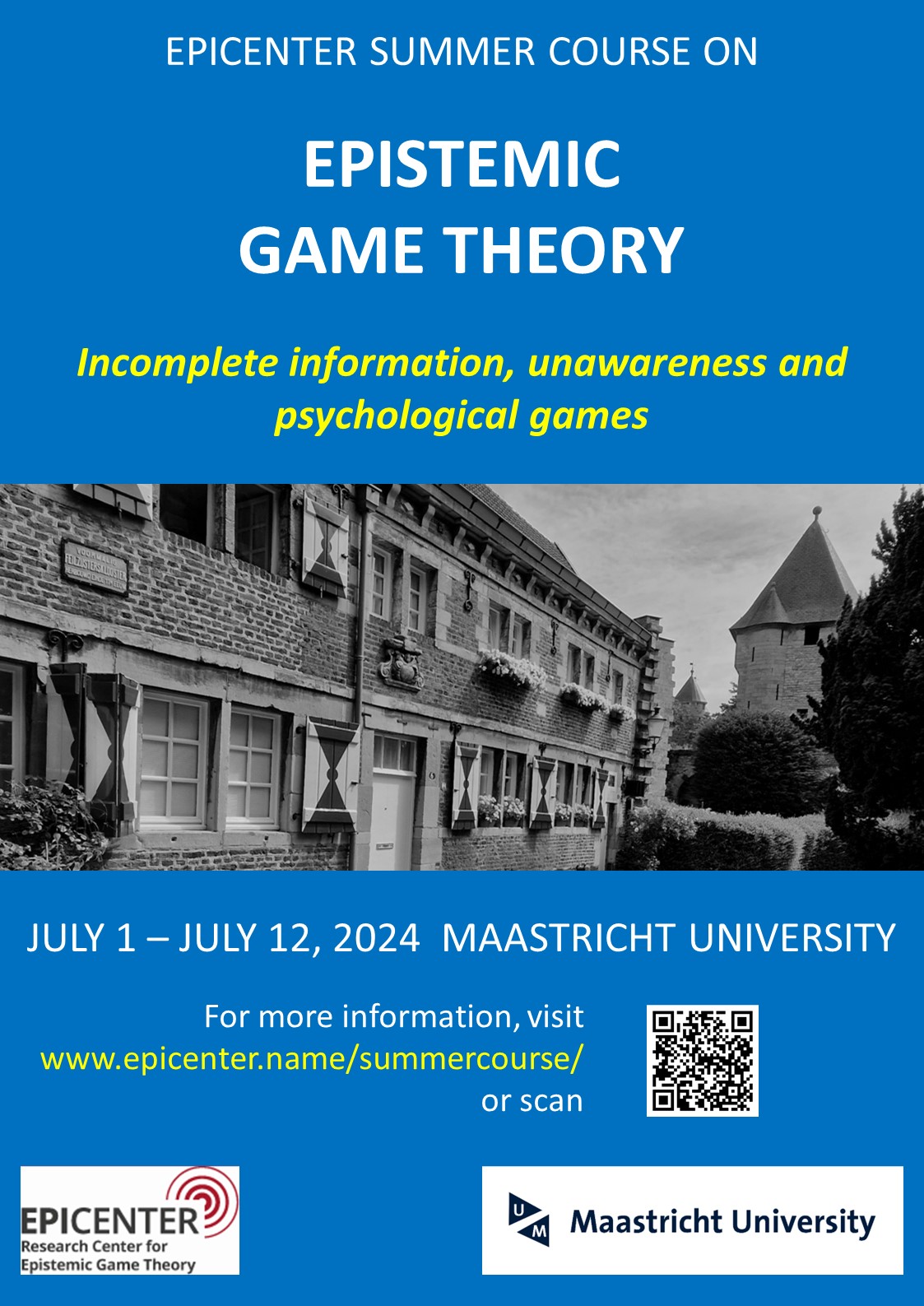
Incomplete information, unawareness and psychological games
July 1 – July 12, 2024
Maastricht University
Registration for the course is no longer possible, since we already have 30 subscriptions, which is the maximum we can take.
Register for course: The registration deadline is June 1, 2024. To register, first pay the registration fee of 80 euros (see below), then make a picture or screenshot of your bank transfer, and subsequently fill in the registration form.
In the registration form, you need to upload this picture or screenshot as a proof that you have paid the registration fee.
Register early: We can only allow 30 students to the course. So please be early with your registration. The first 30 students who register will be able to follow the course.
Registration fee: The registration fee is 80 euros. Please transfer 80 euros, mentioning “EGT course” and your name, to:
Maastricht University
IBAN: NL05 INGB 0657 6187 05, SWIFT (or BIC) code: INGBNL2A
Bank address: ING Bank, Oost-Brabant BB, Schimmelt 36, 5611 ZX Eindhoven, The Netherlands
Beneficiary address: Maastricht University, P.O. Box 616, 6200 MD Maastricht, The Netherlands
Please mention clearly “EGT course” and your name. Otherwise we cannot trace your payment! The fee has to be paid before June 1st, 2024.
Without the payment of the course fee, your registration is not complete.
About this course: The EPICENTER, our research center on Epistemic Game Theory at Maastricht University, offers this two-week intensive course as an introduction to the blooming field of Epistemic Game Theory. This field takes a new, fresh approach to game theory, and studies how people reason in game theoretic situations before they eventually make a choice. More precisely, it explores how we reason about the minds of others before we make a choice. Hence, the reasoning of people like you and me is at the center stage of epistemic game theory.
In this course, we focus on games with incomplete information, games with unawareness, and psychological games. In games with incomplete information, a player may be uncertain about the utility functions of some of his opponents. In a game with unawareness, a player may be unaware of some of the choices that his opponents can make. In a psychological game, the preferences of a player may depend on what he believes that the opponent believes about his choice.
For each of these games, we explore the central reasoning concept of common belief in rationality, and see what happens if we assume correct or symmetric beliefs.
This is the first time we provide a course on incomplete information, unawareness and psychological games. In previous years, our summer course was always on standard (static and dynamic) games. To follow this year’s course, it is not necessary to have followed one of the previous editions. In fact, you should be able to follow this year’s course without having any prior knowledge about game theory. The course is completely self-contained.
Audience: The course is primarily meant for advanced bachelor students, master students and PhD students all over the world, but researchers are also very welcome.
Instructors: The instructors for this course are Christian Bach (University of Liverpool, UK), Rubén Becerril (Universidad Autónoma Metropolitana de Mexico), Stephan Jagau (University of Nottingham, UK), Niels Mourmans (Central Bureau of Statistics, Netherlands), Andrés Perea (Maastricht University, Netherlands) and Joep van Sloun (Maastricht University, The Netherlands) — all members of our EPICENTER. For more information about the instructors, click here
Literature: The course will be based on the new textbook in progress “From Decision Theory to Game Theory: Reasoning about Decisions of Others” by Andrés Perea. The book will be published by Cambridge University Press.
The chapters of the book can be downloaded here.
Organization of the course: The course stretches over 10 days, of which the last day consists of a written exam. Typically, a day consists of two theory lectures and one exercise session, where the two theory lectures cover one chapter from the book “From Decision Theory to Game Theory: Reasoning about Decisions of Others”. In the exercise sessions we will discuss some problems from the book which you should prepare the day before. On the last Thursday, we will discuss a practice exam. Your grade will be based on the exam. To pass the exam, you must score at least a 5.5 out of 10. But you are also free to participate without taking the exam.
Certificate: If you attend at least 20 out of 24 sessions, you will receive an official certificate stating that you successfully followed the course. The certificate also states that the workload of this course corresponds to 6.5 ECTS. If you successfully take the exam, by scoring at least a 5.5 out of 10, you will receive a special certificate which states that you also took the exam, and it specifies the grade you obtained for the exam. At your home university, this should normally be sufficient to obtain 6.5 ECTS for following the course.
Housing: If you would like to rent a room in Maastricht at a reasonable price during these two weeks, please visit: https://www.maastrichthousing.com/ . They offer rooms / apartments at a very reasonable price per day. On their website, indicate that you are a summer school student.
Previous editions: If you want to see some pictures from previous editions, and want to know which students participated and where they came from, please click here
Questions? If you have further questions, please send an E-mail to Andrés Perea at: course@epicenter.name
Slides of theory lectures:
Welcome Decision-problems CBR-in-standard-games
Correct-and-symm-beliefs-in-standard-games
CBR-with-incomplete-information
Simple-symm-incomplete-info-1 Simple-symm-incomplete-info-2
Psych-games-CBR Psych-games-simple-symm-beliefs
Practice exam:
Schedule
Sessions will take place at Maastricht University
School of Business and Economics, Tongersestraat 53
Room A1.22
Maastricht, The Netherlands
